
What Is On-Page SEO vs Off-Page SEO? (Simple Guide)
Introduction
- Audience: If you are a beginner blogger, small-business owner or anyone starting a website and want your pages to rank on Google, this article is for you.
- The Problem / Pain Point: Many new website owners are confused — they don’t know what kind of SEO they should do. Should they just write content? Or build links? What really matters to rank higher?
- Hint of Solution: In this post, you’ll get a clear explanation of what on-page SEO and off-page SEO are — their differences, how to do both correctly, with easy checklists — so you can optimise your site the right way from day one.
On-Page SEO — What Is It?
On-Page SEO (sometimes called on-site SEO) means optimizing all the elements on your own website/pages so that search engines and users both understand what your page is about — and find it useful. Semrush+2raj.thewpsolution.com+2
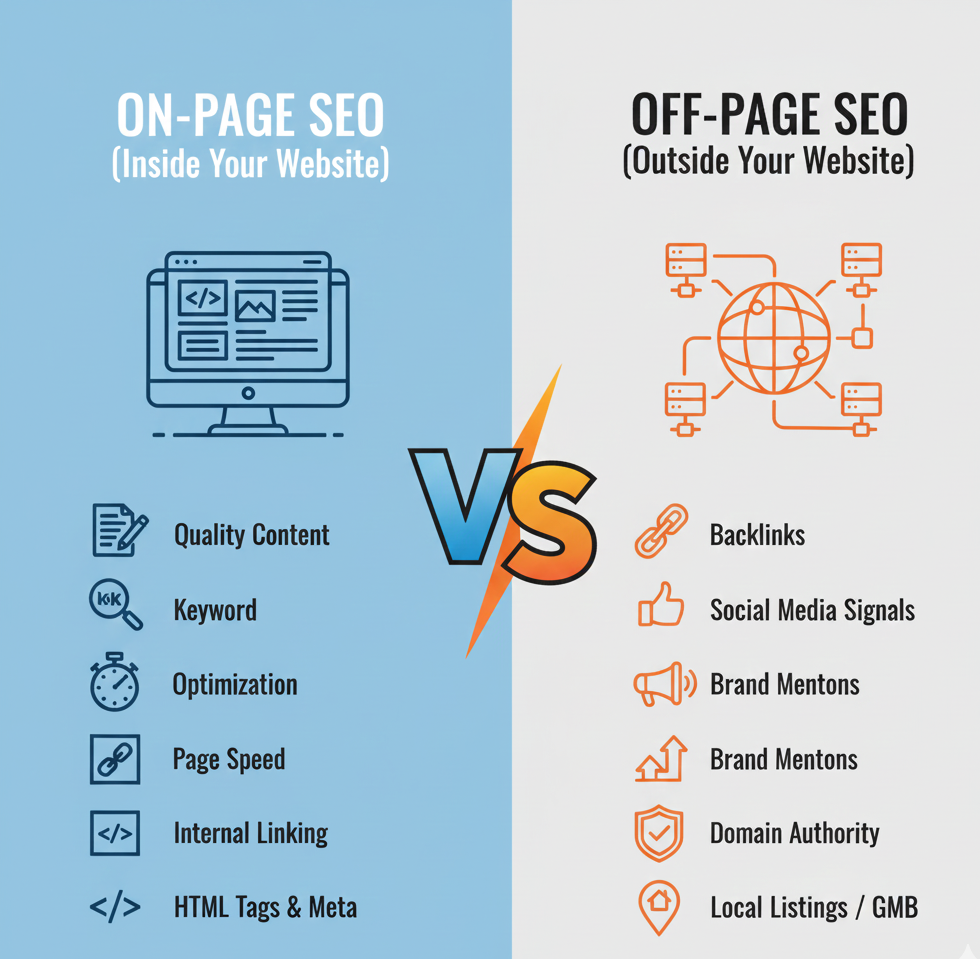
Key On-Page SEO Elements
| Element | What to Do / Why It Matters |
|---|---|
| Title Tag & Meta Description | Use clean, descriptive URLs — ideally with the main keyword — rather than random strings. Makes the page easier to index and understand. Semrush+1 |
| Heading Tags (H1, H2, H3…) | Use H1 for main title, H2/H3 for sections/sub-sections — improves readability & helps search engines understand structure. Docsico+1 |
| Content Quality & Keyword Optimization | Write useful, relevant content. Naturally include your target keyword (and related words) without stuffing. Help users — and signal to Google what the page is about. Expert Market+1 |
| URL Structure / Slug | Use clean, descriptive URLs — ideally with the main keyword — rather than random strings. Makes page easier to index and understand. Semrush+1 |
| Image Optimization (Alt-text, Compression) | Add relevant images/infographics. Use descriptive file names and alt text (with keywords) — helps SEO and accessibility. outranking.io+1 |
| Internal Linking | Link to other related pages/posts on your website — helps spread “link equity,” improves navigation, and helps search engines crawl your site. SEO.com+1 |
| Page Load Speed & Mobile-Friendliness | Ensure your site loads quickly and works well on mobile — good for user experience and important for search ranking. Emeritus Online Courses+1 |
✅ On-Page SEO ensures your page is relevant, readable, and user-friendly — a solid foundation for ranking.
Off-Page SEO — What Does It Mean?
Off-Page SEO refers to actions you take outside your website to build authority, trust, and popularity of your site — mainly by earning signals that show other people/sites value your content.
H3: Key Off-Page SEO Strategies
- Backlinks from Reputable Websites: When other high-quality, relevant websites link to your content, it’s like a vote of confidence. That helps search engines view your site as trustworthy.
- Guest Blogging & Content Promotion: Writing articles for other blogs or platforms, with links back to your site, helps you reach a new audience and get backlinks.
- Social Media Engagement & Shares: Sharing your content, getting engagement, mentions — these social signals (while not as strong as backlinks) still contribute to visibility and build brand awareness.
- Brand Mentions / Online Reviews / Reputation: When authoritative sites mention or discuss your brand — even without a direct link — that adds to your site’s credibility.
🌐 Off-Page SEO is about building your site’s authority and trust beyond your own pages.
On-Page vs Off-Page SEO — Why You Need Both
On-page SEOensures that your site/pages are properly structured, understandable, user-friendly, and relevant to keywords. Without it, even links may not help.- Off-Page SEO adds authority, trust, and reputation — signals that others value your content. Without it, even a perfectly optimised page may struggle to rank high.
- Combined, they give you both relevance and authority. As many SEO experts say, On-Page creates the foundation, and Off-Page gives the boost.
| SEO Type | Control | Main Goal | Typical Time to Impact |
|---|---|---|---|
| On-Page SEO | You control (content, tags, images…) | Relevance + usability | Faster (weeks) brightsideseo.com+1 |
| Off-Page SEO | Depends on external sources (others linking/sharing) | Authority + trust | Slower (months) brightsideseo.com+1 |
On-Page SEO Checklist — What You Should Do When Writing a Blog Post
- Choose a target keyword (e.g., “on page SEO vs off page SEO”)
- Use the keyword in: Title/Title tag, H1, first paragraph, and a few times naturally in body (without stuffing)
- Structure content with H2/H3 subheadings and list/bullet points for readability
- Use a clean URL (slug) with a keyword
- Add relevant images/infographics — compress them and add descriptive alt text (e.g.
alt="on page vs off page SEO comparison infographic") - Internally link to other relevant posts/pages of your site (if available)
- Ensure page loads quickly and is mobile-friendly
Off-Page SEO Strategy — What You Should Do To Promote This Blog Post
- Share your blog post on social media (Facebook, Twitter, LinkedIn, etc.) to get initial visibility
- Reach out to other bloggers/websites for guest posting — include a link to your blog
- Try to get backlinks from relevant and authoritative websites (avoid spammy or low-quality sites)
- Encourage readers to share your post & mention it — that builds social proof and authority
- Engage with communities, forums, or groups related to SEO / digital marketing and share your article if it adds value (without spamming)
Frequently Asked Questions (FAQ)
Q: Which is more important — On-Page SEO or Off-Page SEO?
A: Both are important. On-Page SEO lays the foundation — making your content understandable and valuable. Off-Page SEO gives authority and trust. Without either, ranking will be difficult.
Q: Can I rank with only On-Page SEO (without backlinks)?
A: It’s possible — especially for low-competition keywords. But for competitive keywords/ niches, backlinks (off-page signals) significantly boost ranking chances.
Q: How many backlinks do I need for Off-Page SEO?
A: There’s no fixed number. Quality matters more than quantity — backlinks should come from reputable, relevant websites. A few high-quality backlinks are usually better than many low-quality ones.
Q: Do images and alt-text really matter for SEO?
A: Yes. Optimized images with relevant alt-text help search engines understand your images (and page context), improve accessibility, and can bring traffic from image search.